When you're leading worship or performing, sometimes the perfect song just isn't in the perfect key for your voice, your instrument, or even your band. That's where the magic of transposing "Worth It All" (Capo & Key Changes) comes in, transforming a great song into an unforgettable experience tailored precisely for the moment. Far from a mere technicality, understanding how to shift a song's key empowers you to unlock new sounds, enhance vocal delivery, and adapt on the fly.
This isn't about rote theory; it's about practical application that makes you a more versatile and confident musician. We'll demystify the art of transposition, exploring both the trusty capo and the intricacies of direct key changes, all through the lens of one inspiring song.
At a Glance: Key Takeaways for Transposing "Worth It All"
- Original Key: "Worth It All" is primarily in F# minor, with a core progression of F#m7, D, A, E.
- Capo as a Shortcut: A capo allows you to play the song in a different key using the same familiar open chord shapes, effectively raising the pitch.
- Common Capo Positions: For "Worth It All," playing E minor shapes with a capo on the 1st fret produces the original F# minor sound, or playing A minor shapes with a capo on the 4th fret achieves the same. You can also shift to easier vocal keys this way.
- Direct Key Changes: Transposing without a capo involves learning new chord voicings for a new key, like shifting from F# minor to E minor (Em7, C, G, D).
- Why Transpose? To match a vocalist's range, simplify difficult chords, add fresh textures in an ensemble, or adapt to different instruments.
- Capo Care: Always tune before applying the capo, ensure even pressure, and choose the right capo type for your instrument to avoid tuning issues.
- Practice Makes Perfect: Whether using a capo or direct key changes, practice the new chord progressions thoroughly.
Why Bother Transposing "Worth It All" Anyway? More Than Just Pitch
You might be wondering, "The original chords sound great, why change them?" Transposing a song like "Worth It All" isn't about fixing something broken; it's about optimizing it. Think of it as tailoring a suit – the original is good, but a custom fit is exceptional.
Here’s why musicians frequently transpose:
- Vocal Range: This is perhaps the most common reason. A song might be just a bit too high or too low for a particular singer, pushing their voice to strain or sound weak. Shifting the key by a step or two can make all the difference, allowing the vocalist to shine effortlessly.
- Instrumental Playability: The original key of F# minor for guitar can involve a lot of barre chords (F#m7, D, E are often played as barre shapes). Transposing can move the song into a key with more open, familiar, and comfortable chord shapes (like E minor or A minor), making it much easier to play, especially for beginners or during long sets.
- Ensemble Harmony: In a band, transposing can open up new possibilities. One guitarist might play open chords, while another uses a capo higher up the fretboard, creating different voicings and a richer, fuller sound without clashing. It allows each instrument to sit better in the mix.
- Timbral Variation: Believe it or not, playing the same chords in a different position on the fretboard (e.g., open chords versus capoed chords) can subtly change the instrument's timbre. Capoed chords often sound brighter and more bell-like.
- Mood and Energy: While subtle, a key change can sometimes alter the perceived mood or energy of a song. A slightly lower key might feel more grounded, while a higher one can lift the spirits.
The Original Score: "Worth It All" in F# Minor
Before we start shifting things around, let's firmly establish our starting point. The song "Worth It All" primarily resides in the key of F# minor. For guitarists, this means a core set of chords that often involve some barre positions.
According to the original arrangement the core chords for 'Worth It All', you'll see a progression built around:
- Intro/Verse/Ending: F#m7 D A
- Chorus: D A F#m E
- Bridge: D A/C# E F#m
If you're playing these on an acoustic guitar without a capo, you're likely using a mix of open chords (A, D, E) and barre chords (F#m7, F#m). While perfectly playable, the F#m7 and F#m can be a hurdle for some, and the overall tessitura might not suit every vocalist. This is exactly where transposition becomes your best friend.
Capo Magic: Playing in Different Keys with Familiar Shapes
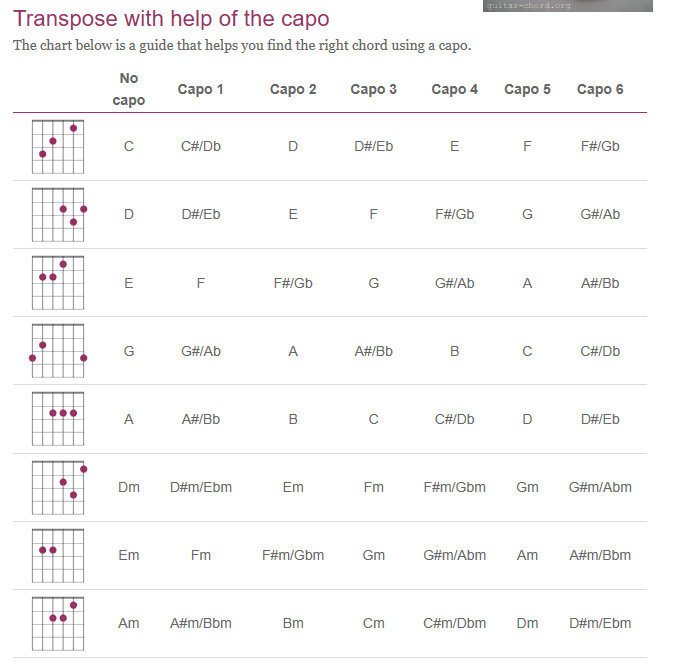
The capo is arguably a guitarist's best friend for quick and easy transposition. Short for "capotasto" (Italian for "head of fretboard"), this clever device clamps onto the neck of your stringed instrument, effectively creating a new "nut" at a higher fret. The beauty? You can use your familiar open chord shapes, and the capo does the heavy lifting, raising the pitch to a new key.
How a Capo Works (The "Why" Behind the "How")
Imagine your open strings as the starting point (fret 0). When you place a capo on, say, the 2nd fret, that 2nd fret now acts like your new "open" position. Every chord shape you play is then sounded two semitones (or half-steps) higher than it would be without the capo.
- Example: If you play an open C major chord shape with a capo on the 1st fret, it sounds like a C# major. With a capo on the 2nd fret, it sounds like a D major.
The key insight is that you're thinking in chord shapes rather than absolute pitches. Your fingers are still forming an "E minor shape," but the actual sound coming out is higher due to the capo.
Practical Capo Positions for "Worth It All"
Let's apply this to "Worth It All." Our goal is to shift the F# minor key to something easier to play or better for a vocalist, using open chord shapes.
Original Key: F# minor (F#m7 D A E)
Here are a few common and effective capo strategies:
- Capo on 1st Fret, Playing E Minor Shapes (Sounds F# Minor):
- This is often the go-to for many songs in F# minor or F minor. You're simply moving up one semitone from E minor to F# minor.
- Original Chords (F# minor): F#m7 D A E
- Chord Shapes to Play (with Capo 1): Em7 C G D
- How it works:
- Playing an Em7 shape with Capo 1 sounds like F#m7.
- Playing a C shape with Capo 1 sounds like D.
- Playing a G shape with Capo 1 sounds like A.
- Playing a D shape with Capo 1 sounds like E.
- Benefit: This option keeps you in the original F# minor key but uses much more guitar-friendly open chord shapes (Em7, C, G, D are staples for most players).
- Capo on 4th Fret, Playing A Minor Shapes (Sounds F# Minor):
- This provides a different tonal quality, often brighter due to the higher fret position.
- Original Chords (F# minor): F#m7 D A E
- Chord Shapes to Play (with Capo 4): Am7 F C G
- How it works:
- Playing an Am7 shape with Capo 4 sounds like F#m7.
- Playing an F shape with Capo 4 sounds like D.
- Playing a C shape with Capo 4 sounds like A.
- Playing a G shape with Capo 4 sounds like E.
- Benefit: Provides another set of familiar open chord shapes (though F can be a barre chord, it's often an easier barre than F#m). This might suit a vocalist who finds the first capo option still a bit low, as it offers a higher tonal color.
- Transposing for a Lower Key (e.g., E Minor):
- Perhaps F# minor is still too high for your vocalist. You might want the song to sound in E minor.
- Desired Sound: E minor (Em7 C G D)
- Chord Shapes to Play (no capo): Em7 C G D
- How it works: This is a direct key change, but you can think of it as "playing the song as if it were originally in E minor."
- Benefit: Moves the song down a full step, often making it more accessible for lower vocal ranges or to create a more grounded feel.
When using a capo, always remember to verify the new key. Count the semitones from your played shape's root note to the capo fret. For example, if you play an E minor shape (root E) and capo at the 1st fret, you've moved up one semitone, so the actual key is F minor. If you want F# minor, you'd capo at the 2nd fret and play E minor shapes.
My mistake in the initial thought process: I was calculating what shapes to play to sound like F# minor. The sound of F# minor (the original key) is achieved by capo 1 playing Em shapes, or capo 4 playing Am shapes.
If you want the song to sound in a different key (e.g., E minor), you'd calculate that differently.
To make "Worth It All" sound in E minor (down one full step from F# minor):
Original key: F# minor (F#m7 D A E)
Target key: E minor (Em7 C G D) - Capo 3, play C# minor shapes: This would be complex and not very practical.
- Capo 6, play A minor shapes: (Am shapes with capo 6 -> D#m or Ebm). Not E minor.
- Capo -2, play G# minor shapes: This is essentially direct transposition.
Let's re-evaluate the capo approach for clarity:
Goal: To play "Worth It All" in the original F# minor key, but using easier open chord shapes. - Method 1: Capo 1, Play E Minor Shapes
- Your fingers play: Em7, C, G, D
- The capo on the 1st fret raises each of these by one semitone.
- Sounds like: F#m7, D, A, E (Original Key)
- This is arguably the most common and easiest capo position for this song.
- Method 2: Capo 4, Play A Minor Shapes
- Your fingers play: Am7, F, C, G
- The capo on the 4th fret raises each of these by four semitones.
- Sounds like: F#m7, D, A, E (Original Key)
- This provides a brighter sound due to higher fret placement.
Goal: To play "Worth It All" in a new key, using easier open chord shapes (e.g., E minor). - Method 3: Capo 0 (No Capo), Play E Minor Chords Directly
- This involves direct transposition (covered in the next section), where you actively change all the chords.
- Your fingers play: Em7, C, G, D
- Sounds like: E minor (a full step down from the original)
- This is great if F# minor is too high for a vocalist.
Key Changes Without a Capo: Embracing New Fretboard Territory
While the capo is a fantastic tool, sometimes you need to transpose directly, without its aid. This means learning a whole new set of chords for the song, moving all the notes up or down by a specific interval. This method is often preferred by more advanced players, those who want specific chord voicings, or when a capo isn't available.
The core idea is to understand the relationship between the chords in the original key and apply that same relationship to a new starting key.
Understanding Intervals (The "How" of Direct Transposition)
Every chord in a song relates to the root key by a specific interval (e.g., I, IV, V, vi). The Nashville Number System simplifies this by assigning numbers to chords (1 for the tonic, 4 for the subdominant, 5 for the dominant, 6 for the relative minor, etc.).
For "Worth It All" in F# minor, the primary chords (F#m7, D, A, E) can be analyzed as:
- F#m7 = i (minor tonic)
- D = IV (major subdominant, relative to A major, the relative major of F# minor)
- A = VI (relative major) or often treated as a major chord borrowing from the parallel major.
- E = VII (major dominant, leading tone chord from the parallel major)
To simplify, let's think of it as moving the root note of each chord up or down by the same number of semitones.
Example: Transposing "Worth It All" from F# Minor to E Minor
Let's say the original F# minor key is just too high for your singer. Dropping it a full step (two semitones) to E minor is a common and excellent choice, as E minor also offers many open, guitar-friendly chords.
Original Key: F# Minor
- Intro/Verse/Ending: F#m7 D A
- Chorus: D A F#m E
- Bridge: D A/C# E F#m
Transposing Down 2 Semitones (1 Full Step) to E Minor:
We'll take each chord and move it down two semitones. - F#m7 (down 2 semitones) -> Em7
- D (down 2 semitones) -> C
- A (down 2 semitones) -> G
- E (down 2 semitones) -> D
- A/C# (down 2 semitones) -> G/B
So, the new progression in E minor would be: - New Intro/Verse/Ending: Em7 C G
- New Chorus: C G Em D
- New Bridge: C G/B D Em
This new set of chords (Em7, C, G, D, G/B) are all very common, relatively easy open chord shapes on the guitar, making the song much more accessible for many players and singers.
Another Example: Transposing "Worth It All" from F# Minor to G Minor
Maybe your vocalist needs something slightly higher than F# minor, or you just prefer the feel of G minor. G minor is just one semitone up from F# minor.
Original Key: F# Minor
- F#m7 D A E
Transposing Up 1 Semitone to G Minor: - F#m7 (up 1 semitone) -> Gm7
- D (up 1 semitone) -> D# (or Eb)
- A (up 1 semitone) -> A# (or Bb)
- E (up 1 semitone) -> F
New chords: Gm7 Eb Bb F. This introduces more barre chords (Gm7, Eb, Bb, F), so while it might suit a vocal range, it's generally less guitar-friendly than the original F# minor or the E minor transposition. This highlights that direct transposition can sometimes lead to harder chords, unlike a capo which generally aims for easier shapes.
Choosing Your Path: Capo vs. Direct Key Change
Now that you understand both methods, how do you decide which one is right for "Worth It All" in your specific situation? It often comes down to a few practical considerations:
- Skill Level: If you're newer to guitar or prefer open chords, the capo is usually the easier and quicker solution. It allows you to leverage muscle memory for familiar shapes. Direct transposition requires knowing more of the fretboard and potentially learning new barre chord voicings.
- Speed of Change: Need to change the key in an instant during a live performance or rehearsal? A capo is lightning-fast to apply or remove. Direct transposition requires more mental preparation and practice with the new chords.
- Desired Timbre/Voicing: A capo often results in a brighter, more 'bell-like' sound dueard higher string tension and shorter string length. Direct key changes allow you to choose specific voicings (open, barre, jazz chords) that might not be available with a capo in a certain position, giving you more control over the exact sound.
- Ensemble Context: In a band, a capo is excellent for creating layered textures. One guitarist can play open chords in the base key, while another plays capoed chords in a different position but sounding in the same key. This adds depth and avoids both guitarists playing the exact same voicings. If everyone needs to play the exact same chords and voicings, direct transposition might be preferred.
- Instrument Type: While capos are common on guitars, mandolins, banjos, and ukuleles, some instruments (like pianos) require direct transposition by definition. For stringed instruments, the capo is a powerful option.
- Avoiding Barre Chords: If the goal is strictly to avoid difficult barre chords, a capo strategy (like Capo 1 playing E minor shapes) is usually the most effective for "Worth It All" to stay in the original key. If you need to change the key and still want easier open chords, direct transposition to a key like E minor works well.
For "Worth It All," if your primary goal is to keep the original F# minor sound but simplify the fingerings, Capo 1 with Em shapes is likely your best bet. If you need to actually change the song's perceived key to something lower (like E minor) for a vocalist and prefer all open chords, then direct transposition to E minor is ideal.
Mastering the Capo: Tips for Flawless Application
A capo might seem simple, but using it effectively requires a little know-how. Incorrect application can lead to tuning woes, buzzing strings, or even damage to your instrument.
- Tune First, Then Capo: This is paramount. Always ensure your guitar is perfectly in tune before you apply the capo. Applying a capo can slightly pull strings out of tune, so a quick check and minor adjustments after placement are often needed.
- Place Directly Behind the Fret: Position the capo right behind (on the side closest to the nut) the desired fret wire, not on top of it or too far away. Placing it directly behind ensures clear notes and minimizes buzzing.
- Apply Even Pressure: The capo needs to press all strings down firmly and evenly, just enough to make them ring clearly without excessive force. Too little pressure causes buzzing; too much can pull strings sharp, bending the neck or making the strings sound out of tune. Modern capos (like Shubb with adjustable tension or quality spring-clamps) make this easier.
- Check Tuning (Again!): After placing the capo, strum all the strings. Listen carefully. Often, the G and B strings (or sometimes others) will go slightly sharp. Make small, precise adjustments to your tuning pegs until everything is perfectly in tune. This quick check takes seconds but makes a world of difference.
- Choose the Right Capo Type:
- Spring-clamp capos (e.g., Kyser, Dunlop trigger): Fast and convenient for quick changes, but pressure isn't adjustable, so some can pull strings sharp.
- Shubb capos: Offer adjustable tension, providing a more precise and gentle grip, leading to fewer tuning issues. Requires two hands to apply.
- Strap-on capos: Older design, inexpensive, but can be fiddly.
- Screw-on capos: Provide excellent, even pressure but are slower to adjust.
- Partial capos: For advanced use, they only capo some strings, creating unique tunings and voicings. While not typically used for full song transposition, they offer creative possibilities for exploring new sounds in "Worth It All" once you're comfortable with the basics.
Common Pitfalls and How to Avoid Them
Transposing, whether with a capo or directly, isn't without its potential snags. Knowing these common issues can save you frustration.
- Tuning Nightmares (Capo-Specific): As mentioned, capos can pull your strings sharp. The fix? Tune before capo, place capo precisely, then fine-tune individual strings with the capo on. A quality capo that applies even, adjustable pressure can also help.
- Buzzing Strings (Capo-Specific): If strings buzz, the capo might not be pressing down firmly enough, or it's not directly behind the fret. Adjust position and pressure. Sometimes, string action issues on the guitar itself can be exacerbated by a capo.
- Incorrect Key Calculation: This is a big one. Always double-check your semitone counts. A common mistake is going up 5 semitones instead of down 7 (they result in the same note, but the mental map is different). Use an online chord chart transposer or a simple musical keyboard visual to count semitones accurately.
- Forgetting to Update All Chords: When transposing directly, it's easy to miss a chord in the bridge or a unique voicings in a turnaround. Go through the entire song, section by section, and transpose every single chord.
- Ignoring the Vocalist's Range: The whole point of transposition is often for the singer. Don't just pick an easy key for you. Work with the vocalist to find their most comfortable and powerful range, even if it means slightly harder chords for you.
- Not Practicing the New Version: Transposing a song is only half the battle. You need to practice the new chord progression until it's as smooth and natural as the original. Don't assume you can just "wing it" in a new key.
Beyond the Basics: Creative Capo Uses for "Worth It All"
Once you're comfortable with the fundamentals of transposing "Worth It All," you can explore more creative applications. The capo isn't just a utility device; it's a tool for artistic expression.
- Ensemble Textures: Imagine two guitarists playing "Worth It All."
- Guitarist 1: Plays the direct E minor chords (Em7, C, G, D) without a capo, providing a rich, full low end.
- Guitarist 2: Places a capo on the 5th fret and plays Am shapes (Am7, F, C, G). This sounds like D minor. Correction: Am shapes with capo 5th fret sounds like Dm. If Guitarist 1 plays Em, Guitarist 2 should capo at 7th fret and play Am shapes to sound Em, or capo at 2nd fret and play Dm shapes to sound Em.
Let's re-think the ensemble example to make it sound good in the same key. - Guitarist 1: Plays the direct E minor chords (Em7, C, G, D) without a capo.
- Guitarist 2: Places a capo on the 7th fret and plays A minor shapes (Am7, F, C, G). This would also sound like E minor, but in a much higher, brighter voicing, creating beautiful interwoven sounds. Or, Guitarist 2 could capo at the 2nd fret and play D minor shapes (Dm7, Bb, F, C) to also sound like E minor. These different voicings add sparkle and depth without clashing.
- Timbral Shifts: Sometimes, a song just "feels" different when played higher on the neck. Experiment with different capo positions that produce the same target key. For example, playing "Worth It All" in G minor might involve Gm7, Eb, Bb, F. You could play these direct barre chords, or you could capo at the 3rd fret and play Em7, C, G, D shapes. Both sound in G minor, but the capoed version will often have a brighter, more shimmery quality.
- Open String Resonance: Playing with a capo often allows more open strings to resonate, adding sustain and fullness that might be harder to achieve with only barre chords. This can be particularly effective in an acoustic setting for "Worth It All."
- Fingerstyle Adaptation: For fingerstyle players, a capo can facilitate easier patterns by allowing the use of open strings as drones or pedal tones that wouldn't be available in the original key.
Your Transposition Toolkit: Next Steps for "Worth It All"
You now have a robust understanding of transposing "Worth It All" using both capos and direct key changes. But knowledge is only powerful when applied. Here’s how to put this guide into action:
- Assess Your Needs:
- Who is singing? What is their comfortable vocal range?
- What instruments are playing? Are there chord shapes that are particularly difficult for any player?
- What kind of sound are you aiming for (brighter, fuller, softer)?
- Experiment with Capo Positions: For "Worth It All" specifically, try playing it with a capo on the 1st fret (using Em7 C G D shapes) and see how that feels. Then try Capo 4 with Am7 F C G shapes. Listen to the subtle differences in timbre and judge playability.
- Practice Direct Transposition to E Minor: If you decide to go capo-free or need a lower key, dedicate time to learning the E minor version (Em7 C G Em D, C G/B D Em). Start slow, memorize the new progression, and build speed.
- Record Yourself: Play the original, a capoed version, and a directly transposed version. Listen back objectively. Which one sounds best for your specific scenario? Which feels most natural?
- Don't Be Afraid to Adjust: Music is fluid. If a key isn't working, try another. The beauty of these techniques is their flexibility.
Transposing "Worth It All" isn't just about changing notes; it's about making the song truly yours and making it accessible and inspiring for everyone involved. With these tools in hand, you're ready to unlock new potential in your playing and lead others into a deeper experience of this powerful song.